Kyiv's subway stations now house thousands as Russian strikes intensify
With shelter shortages forcing residents to sleep underground, the Ukrainian capital faces its deadliest year since the 2022 invasion began.
By Marcus Johnson ·
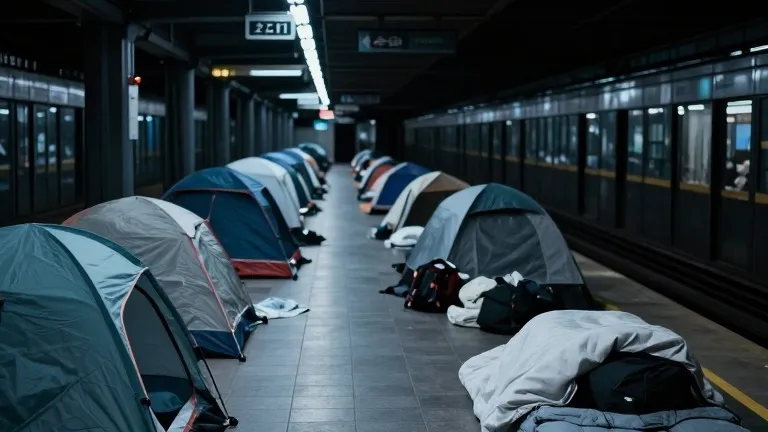
Subway stations in Kyiv have become temporary homes for thousands of residents as Russian attacks on the capital intensify. The city of four million does not have enough designated shelters to accommodate everyone during air raids. Consequently, people set up makeshift living spaces in the underground transit system. From approximately 10 p.m. each night, residents lay out mattresses and pitch small tents along the cold walls. Children sleep beside their parents, and pets rest among strangers in the dimly lit tunnels. This routine has replaced the relatively calm daily life that existed in the capital just a few months ago.
Residents describe the psychological and physical toll of this new normal. Halyna, a woman living in the Lukyanivka district, told reporters that she takes her five-year-old son, Roman, to the nearest station most evenings. She often goes even when no siren has sounded. "We're alive," she said while holding her child. "We've been lucky once again." Her area has been targeted repeatedly during the four and a half years of conflict. The decision to move underground is driven by fear of repeated missile and drone strikes.
Recent attacks have claimed the lives of children and damaged residential buildings. In September, a Russian drone struck an apartment complex in the central Pechersk district. Daniel Umanskyj, a 14-year-old student, was doing his homework in his room at the time of the impact. His neighbor, Vlad, was in the hallway with his daughter. Vlad said he arrived late that evening, a delay he believes saved their lives. "These sick monsters don't care who they kill," he said. Flowers now sit outside the damaged building in memory of Daniel.
Schools are also affected by the fighting. In early October, a drone hit a school building in the southwestern part of the city. Principal Valentyna Chorna stated that pupils and teachers were already in shelters when the strike occurred. The school continues to hold in-person classes for students in grades one through nine. This is possible because the facility has a large shelter that can hold more than 500 students. Attendance depends on the duration of air raid alerts and the availability of safe spaces. If an alarm sounds while children are at home, they may miss their lessons.
The disruption creates stress for parents who must balance work and safety. One parent noted that the walk to school is risky because alerts can begin at any moment. A Russian drone also struck the building where she lives in September. Her apartment suffered no damage, and her daughter was at school when the hit occurred. These incidents contribute to a growing uncertainty about the city's infrastructure.
Kyiv's military administration reports that 140 people were killed in the capital during the first eight months of 2026. This figure already exceeds the 172 deaths recorded for all of 2025. If the current pace of casualties continues, 2026 will be the deadliest year for Kyiv since the full-scale invasion started in 2022. The rising toll is accompanied by shortages of essential goods. Strikes on warehouses have led to supermarket supply issues not seen since the early months of the war.
Energy infrastructure remains a critical concern. Emergency power outages returned at the end of September. A Russian attack also paralyzed the subway system for a period. With the energy grid under fire, city officials face the challenge of providing reliable heat, electricity, and water for the upcoming winter. The physical state of the grid determines how long residents must stay in shelters.
Despite the hardships, many residents say they are prepared to continue. A survey by the Kyiv International Institute of Sociology found that 72% of city residents said in September that they are ready to endure the war as long as necessary. Authorities are adjusting regulations to maintain some normalcy. The curfew now runs from 1 a.m. to 5 a.m. instead of the previous longer duration. Some public facilities are allowed to operate during yellow alerts. During red alerts, which indicate the threat of ballistic or cruise missiles, people must take shelter immediately.
The next few weeks will test the city's ability to manage these changes. Authorities are monitoring the energy grid closely as temperatures drop. The military continues to track incoming threats from multiple directions. Residents continue to prepare their personal shelters in the subway and other public spaces. The balance between daily work and survival remains a primary focus for families in the capital.
Source: Deutsche Welle