Lunar Water Reserves Could Sustain One Million Residents for Only One Century
New analysis by Harvard and Durham researchers indicates that water scarcity, not power, will determine the size of future moon bases.
By Noor Haddad ·
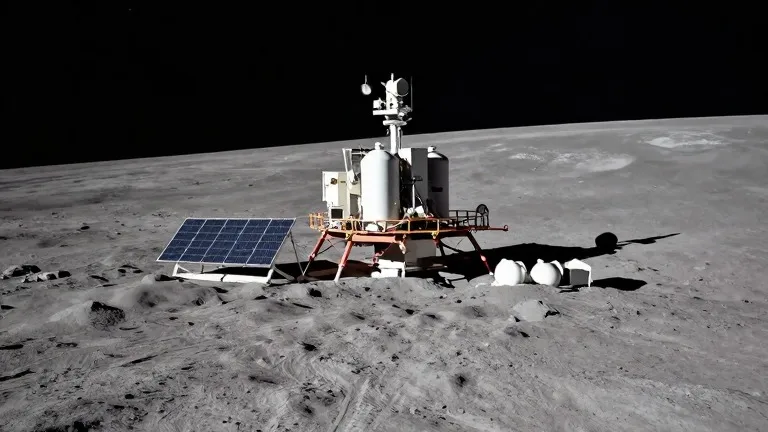
Engineers designing permanent bases on the moon now have a hard ceiling for population size based on available water. A new study published in Frontiers in Space Technologies estimates that a community of one million people could exhaust the moon's accessible water supply in approximately 100 years. This limit assumes that 98 per cent of all water is recycled, matching the efficiency rate currently achieved on the International Space Station.
The analysis was prompted by recent public claims from major space companies. In February 2026, SpaceX CEO Elon Musk stated on social media that the company was pivoting from Mars to building a self-growing lunar city within a decade. Separately, Blue Origin CEO Jeff Bezos predicted that millions of people would live in space by 2045. Martin Elvis, a senior astrophysicist at Harvard University's Smithsonian Astrophysical Observatory, and Jonathan McDowell, an honorary professor at the Durham University Space Research Centre, calculated whether the moon's resources could support those projections.
The researchers found that power generation poses no major obstacle. Solar and nuclear energy sources would be sufficient to sustain a million-person population. Water remains the limiting factor. Most lunar water is believed to exist in permanently shadowed regions at the poles. The study assumes a total reserve of roughly one billion tonnes, a figure consistent with current scientific estimates.
Martin Elvis noted that while one billion tonnes sounds substantial, it is modest in scale. He described the volume as comparable to a small lake, which cannot supply a large city for long. If a settlement were limited to 10,000 people, the same water reserves would last for centuries. However, Elvis argued that the one-billion-tonne estimate may be overly optimistic. He suggested the actual amount is 20 to 30 times smaller and that only one-third to one-half of the water is recoverable. His best estimate is that usable water amounts to only one per cent of the original figure, reducing the lifespan of a million-person city to roughly one year.
Gordon Osinski, a professor of planetary geology at Western University in London, Ontario, added that satellite measurements contain uncertainties. He believes the water is present but requires on-ground confirmation. Osinski described the potential form of the water as similar to Arctic permafrost, where sub-millimetre ice crystals are mixed into soil, making extraction difficult.
Jonathan McDowell emphasized that the findings clarify constraints rather than negate the possibility of settlement. He stated that the goal is to identify what will work so that resources are not wasted on projects that are not feasible.
The paper does not specify a timeline for future missions, but it provides a quantitative framework for planners. The next step for the scientific community involves ground-based verification of water composition and quantity in polar regions.
Source: CBC News