Serbia Election: Student List Aims for 40% Vote in First True Contest Since 2012
Polls suggest the anti-government movement may secure nearly half the parliamentary seats, while the ruling party warns that change brings chaos and foreign interference.
By Mei Ling ·
Serbians go to the polls on Sunday to choose their next parliament in an election that political scientists say is the first competitive contest since Aleksandar Vucic took power in 2012. The uncertainty hangs over the campaign as the Student List, a group formed by protesters who have been on the street for nearly two years, challenges the four decade hold of the Serbian Progressive Party. For voters, the choice is framed as a decision between a break from the past and a continuation of the status quo.
Dusan Spasojevic, a political scientist, told Deutsche Welle that surveys indicate the student group could capture more than 40% of the vote. If accurate, this result would force the ruling party to seek coalition partners or trigger a post-election crisis. Spasojevic noted that a narrow margin is the most likely outcome, and that any slim victory for the incumbent would probably be contested.
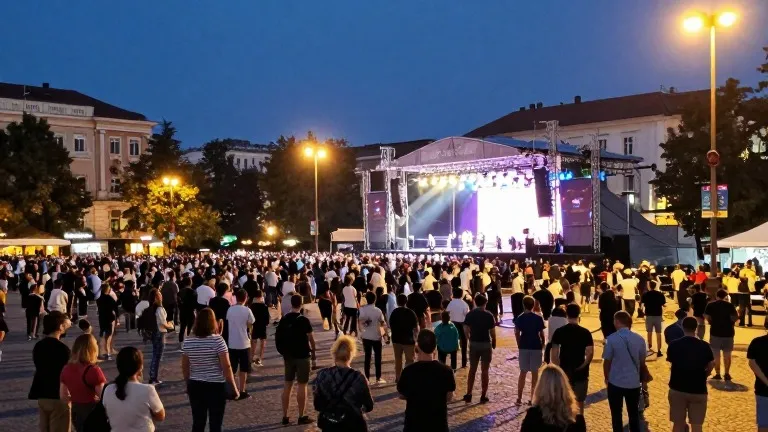
The Student List gained momentum after a concrete canopy collapsed at the Novi Sad railway station in November 2024, killing 16 people. The movement has used that disaster to demand accountability and position itself as an alternative to the traditional ideological divisions in Serbian politics. In Belgrade on Thursday, thousands of supporters gathered for the group's final rally. Many had walked for days from other parts of the country to show solidarity.
Arsa Stojanovic, a biology student, told the crowd that the walkers had visited villages and neighborhoods across Serbia. He said the journey proved that the movement could count on ordinary people. Aleksandar Cupic, a transport engineering professor and candidate for the list, told the audience that it smelled like freedom. The event ended with a kolo, a traditional circle dance.
The Serbian Progressive Party held its own closing rally a few kilometers away. Its message focused on stability, continuity, and prosperity. Former President Vucic accused opponents of serving foreign interests and claimed that they had attacked the party with billions of euros. He framed the election as a battle for the country's sovereignty and future.
The campaign has been marked by disputes over fairness. The independent monitoring group CRTA recorded 116 incidents of physical violence or verbal threats during the final week. These included attacks on campaigners and attempts to seize banners. CRTA also reported that police were sometimes slow to protect opposition candidates and that activists faced surveillance and questioning.
The group said the campaign was not free or fair. Its report found that nearly three-quarters of airtime on national television went to government representatives. More than 80% of the coverage of the Student List was negative. The Balkan Investigative Reporting Network published testimony from a former party member who described pressure on public-sector employees to deliver votes.
Anonymous sources told Deutsche Welle that voters were offered between 30 and 150 euros, and in some cases holiday packages, to support the ruling party. Independent media have also reported on alleged links between people connected to the party and criminal networks. Spasojevic doubts these revelations will change the final result, but they have fueled suspicions about the integrity of the process.
Tensions remain high as election day approaches. Authorities have warned that the students are preparing street violence with the help of foreign intelligence services. Several people have been arrested on suspicion of plotting disturbances for the night of the vote. The Student List has vowed to defend every ballot.
An EU Commission spokesperson told Deutsche Welle that key recommendations on improving Serbia's electoral framework remain unimplemented. The EU has emphasized that democracy and the rule of law are central to the accession process. Serbia has been an EU candidate country since 2012, and the bloc is watching the vote closely to gauge the next steps in the country's relationship with Europe.
Source: Deutsche Welle